How to Structure Your Contact Network Using a Private Map System

How to Structure Your Contact Network Using a Private Map System
Most professionals today don't struggle because they lack contacts. They struggle because their contacts lack structures.
Over time, numbers pile up. Clients, collaborators, vendors, leads, acquaintances, service providers, and communities all quietly enter the same contact list. In the beginning, this feels manageable. You remember people. You roughly know where they are. You can still rely on memory.
Then the network grows.
At some point, clarity begins to disappear. You know the right people exist somewhere in your phone, but when you actually need them, things become uncertain. You are not sure who is nearby. You hesitate about who to call first. Planning becomes slower. Follow-ups become inconsistent. Your contact list keeps growing, but its real usefulness quietly declines.
The problem is not quantity. It is the absence of a system.
A professional network does not only store information. It supports thinking, planning, and decision-making. When there is no visible structure, even a strong network slowly loses its practical power. Research from Harvard Business Review on professional networks emphasizes that the value of relationships often depends on how effectively individuals organize and activate their connections, not simply how many contacts they have.
Why traditional CRMs quietly fail at managing real networks
When professionals hit this stage, many turn to CRMs. On paper, this feels logical. CRMs promise organization, control, and visibility. In practice, most of them are built for pipelines, not people.
They are designed around deals, stages, reports, and sales workflows. They work well when the primary problem is tracking revenue. But a real professional network is not a sales pipeline. It is fluid, relationship-driven, and deeply connected to geography, context, and timing.
This is why many professionals experience CRM fatigue. The tools become heavy. Simple actions require too many steps. Information becomes buried. The system demands maintenance instead of offering clarity. Instead of supporting daily decisions, it turns into another database that needs constant feeding. Industry research from Gartner notes that CRM systems often face user adoption challenges because professionals find them complex and overly administrative for everyday relationship management.
The result is predictable. The CRM exists, but the real network still lives in the user's head. And memory, once a network grows, is never a reliable system.
What a private map system actually means
A private map system approaches the problem from a completely different direction.
It does not try to turn relationships into records. It turns them into a visible network.
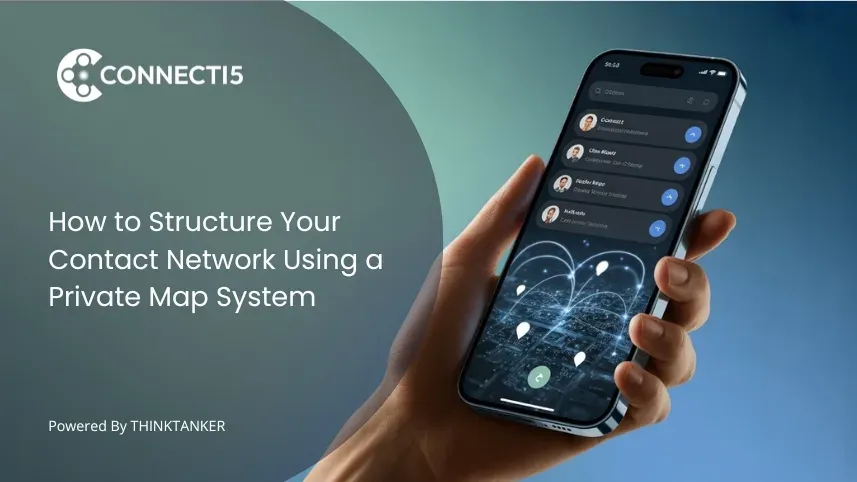
A private map system is a secure, personal environment where your contacts are represented spatially. Instead of existing only as names in a list, your network appears as a living map. You can see where people are, how they are distributed, and how different parts of your network relate to one another.
This visibility changes everything.
When your network is mapped privately, you stop managing contacts and start navigating a system. Instead of guessing, you observe. Instead of searching, you recognize. Instead of remembering, you understand.
A private map system gives shape to something that was previously invisible.
The structure behind an effective private map system
A powerful private map system is not a single feature. It is a layered structure that quietly supports how professionals think and act.
It begins by bringing your contacts into one private, controlled environment. When your network lives across phones, spreadsheets, and scattered tools, no structure can truly exist. Centralization is not about storage. It is about creating a foundation where relationships can be organized without friction.
Once contacts live in one place, location becomes the next dimension. When people are visible on a private map, the network gains geography. Patterns begin to emerge. Proximity becomes clear. Planning becomes grounded. You are no longer dealing with abstract names. You are dealing with presence.
On top of that, segmentation brings relational meaning. A mature network is not one group of people. It is many overlapping networks. Clients, collaborators, personal relationships, professional communities, and opportunity layers all coexist. A private map system allows these dimensions to exist simultaneously, so your network can be filtered, grouped, and understood based on purpose rather than memory.
Usability then becomes critical. A system only supports thinking if it can be navigated easily. When a private map system allows quick searching, filtering by distance or category, and visual scanning, it removes mental load. The right people become easier to find. The right decisions become easier to make.
Finally, action completes the structure. A private map system must not end at clarity. It must flow into execution. When visibility connects directly to calling, messaging, navigating, and planning, the network becomes operational. It starts participating in daily work instead of sitting passively in the background. McKinsey research on digital productivity highlights that tools which surface relevant information contextually can significantly improve decision speed and workplace efficiency.
How professionals structure their networks with private maps
Professionals who adopt private map systems rarely describe them as tools. They describe them as working environments.
Consultants and freelancers often use private maps to create a living view of clients, collaborators, and professional relationships. When they travel, plan projects, or explore opportunities, the map gives immediate context. They no longer think in terms of contact lists. They think in terms of networks.
Field-based professionals experience an even more visible shift. Salespeople, service providers, and operators who move between locations rely heavily on spatial clarity. When contacts are mapped privately, planning stops being reactive. Routes become intentional. Visits become strategic. The network stops being something to manage and becomes something to work with.
Business owners use private maps to gain control over complex ecosystems. Customers, partners, vendors, and teams stop existing as scattered information and start appearing as a connected landscape. This perspective supports better decisions because it reveals how the business network actually exists in the real world.
Relationship-heavy roles such as real estate, recruitment, and consulting benefit deeply from this shift. Their work depends on seeing patterns, understanding presence, and recognizing opportunity clusters. LinkedIn’s networking research consistently shows that professionals who actively map and maintain their networks are more likely to discover opportunities through existing connections.
Private maps turn these patterns into something visible instead of something imagined.
Why private map systems outperform lists, spreadsheets, and CRMs
Lists store. Spreadsheets organize. CRMs track.
Private map systems reveal.
They introduce a visual and spatial layer that traditional tools cannot provide. Instead of requiring interpretation, they offer perception. Instead of demanding memory, they support recognition. Instead of managing transactions, they support relationships.
This difference is subtle, but it is structural. It changes how professionals interact with their networks, not just how they record them.
Where Connecti5 fits in this shift
Connecti5 was built around this exact idea.
Rather than extending the contact list model or replicating CRM logic, it focuses on private contact mapping. It provides a way to see your personal network on a private map, organize it through groups and tags, filter it by distance and relevance, and move from visibility to action without friction.
Its role inside a private map system is simple but powerful. It turns contact lists into usable networks. It transforms scattered information into a structured, navigable environment. And it keeps that environment private by design.
Instead of asking users to maintain a system, it gives them one that quietly supports how they already work.
What changes when your network becomes a private map
When a contact network becomes a private map, the most noticeable change is not technical. It is cognitive.
Decisions become faster. Planning becomes easier. Relationships become easier to maintain. Opportunities become easier to recognize. The mental effort required to manage a growing network drops sharply.
You stop carrying your network in your head.
You start working inside it.
And when that happens, your network shifts from being a background resource to becoming a strategic asset.
Final thoughts
Your network is one of your most powerful professional assets. But without structure, even the strongest network slowly loses its effectiveness.
A private map system restores that structure. It gives your relationships shape, your connections clarity, and your decisions a foundation.
When a network becomes visible, it becomes usable.
And when it becomes usable, it becomes leverage.